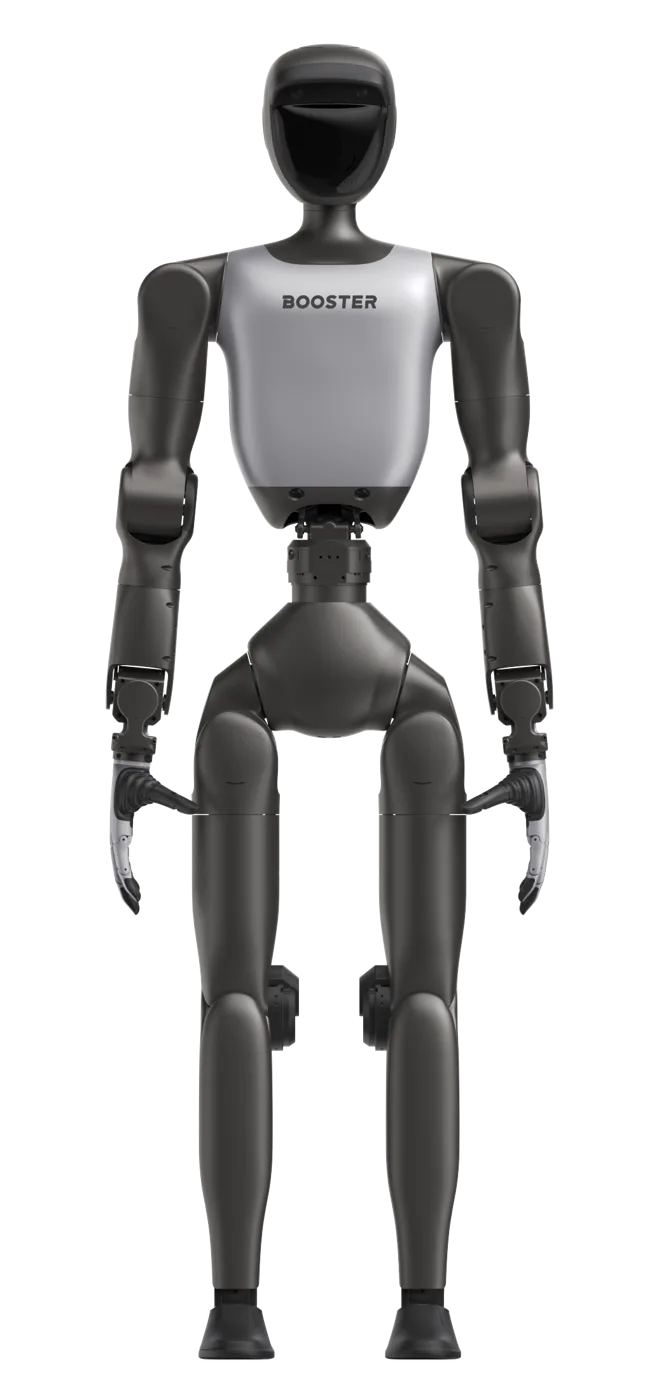
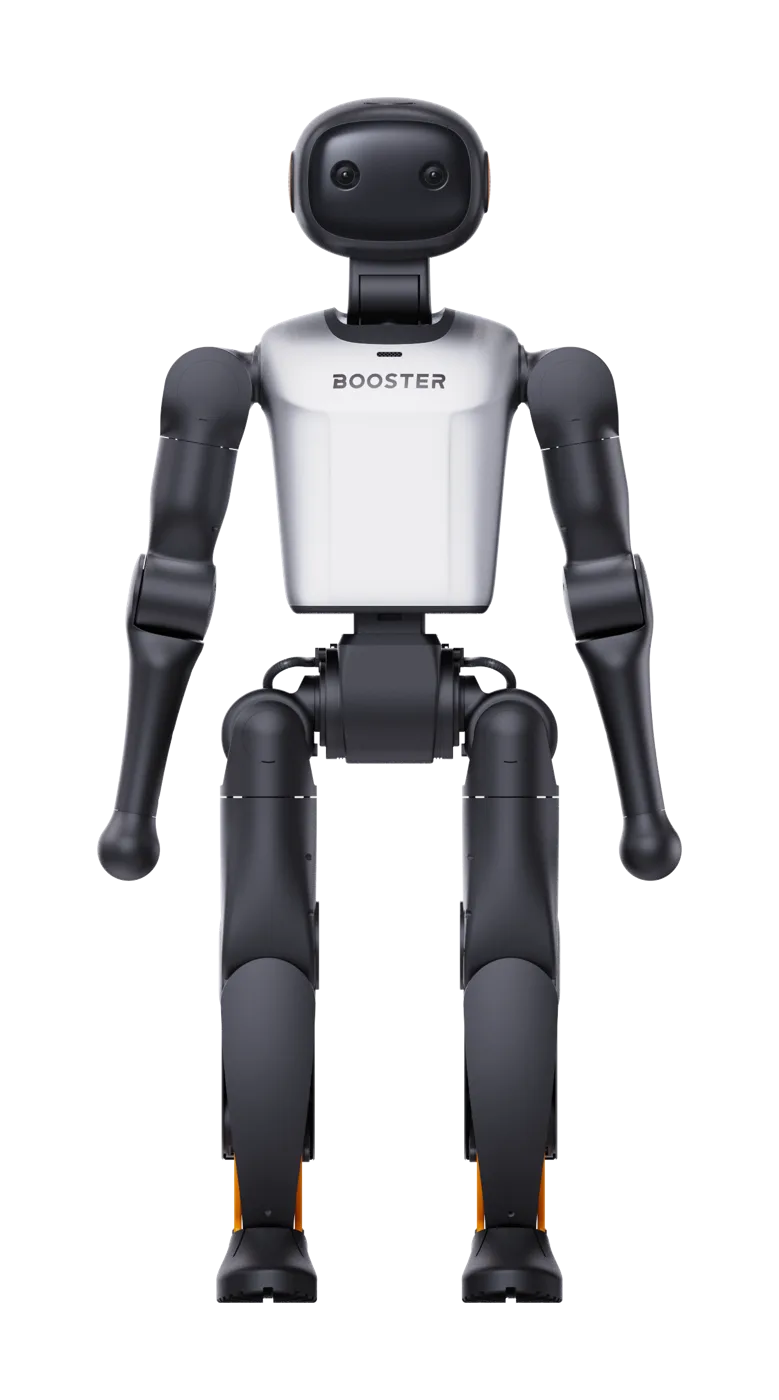
The K1 is built as an entry into humanoid robotics, for classrooms, courses and competitions, not as a demonstration piece. At ninety-five centimetres and around twenty kilograms one person can carry it, twenty-two driven joints take it through the room on two legs, and every joint carries two encoders, which keeps the control loop clean even when somebody runs code of their own on it. That is the point: control, perception and motion are open, the machine ships with a depth camera, an IMU and a microphone array, and developing your own routines is explicitly provided for by the manufacturer. At RoboCup 2026, thirty-eight of the fifty-nine humanoid-league teams ran on Booster machines, and all three championship titles went to teams using them. The difference between the four versions lies not in the mechanics but in the compute module, the battery and the warranty.
Technical data
- Height
- approx. 950 mm
- Weight
- approx. 20 kg
- Degrees of freedom
- 22 (legs 12, arms 8, head 2)
- Joint torque
- up to 60 Nm peak
- Walking speed
- over 1 m/s
- Encoders
- two per joint
- Perception
- Stereo depth camera, 9-axis IMU, circular 3-microphone array, speaker
- Connectivity
- Wi-Fi 6, Bluetooth 5.2, gigabit Ethernet expansion port
- Own programming
- yes, ROS 2 and Isaac Sim support from the factory
- Language model
- Doubao, six months included
- Included
- Remote control and charger
- Compute
- Nvidia Jetson Orin NX 8 GB, 117 TOPS
- Battery
- 5 Ah
- Walking time
- around 80 minutes
- Manufacturer warranty
- 12 months, plus one year of technical support
- Transport case
- included
Source of the data: Figures from booster.tech (14 September 2026) and the Booster Partnership Guide (4 September 2026)
CHF 15'242
one off, incl. VAT